Event Video Production
GACC West 3rd Mobility Dialogue — San Francisco
Read Full Transcript of This Video
Transcript: GACC West 3rd Mobility Dialogue — San Francisco
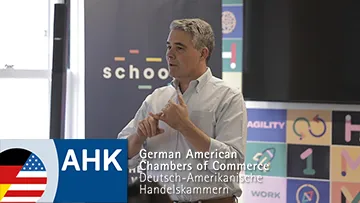
**Kristian Wolf, CEO, German American Chamber of Commerce West:** We're probably seeing the biggest changes in the mobility sector since the invention of the automobile. Basically revolutionizing the way people get from A to B.
We're absolutely delighted to host our third mobility dialogue here in San Francisco and Silicon Valley between our German and American partners. A very important topic right now, autonomous driving, the future of cities, they go together hand in hand at the beautiful consulate in San Francisco.
**Rodney Slater, former U.S. Secretary of Transportation:** We see it as an opportunity to really be in conversation with leaders in the space from not only the United States but really across Europe. We think that the German-American Chamber of Commerce is a wonderful facilitator and we're very proud to be a sponsor.
**Jennifer Elftmann, Innovation Manager IoT, Plug and Play Tech Center:** I think it is super important to engage in these dialogues because I truly believe that we cannot find a solution within one corporate or within one start-up or within one government. I think this is a joint effort.
**Steven Shladover, Research Engineer, UC Berkley:** I think it's really beneficial to bring together thought leaders from the different sectors of society to exchange ideas because we all learn from each other by doing that.
Driving a vehicle out in public traffic is a really complicated thing to do.
**Cecilia Tenge-Rietberg, Project Coordinator, Germany Trade and Invest:** I think the space that we'll see the most growth or change or impact here will be tech regulation.
**Ashley Tarver, Big Data Evangelist, Cloudera:** There's a lot of gaps in how the data that we've managed and secured, which really brings up huge opportunities for smaller start-ups.
So these smaller companies are going to invent new technologies to help make autonomous driving work, and those companies have enormous upside if they can do it right.
**Thomas Becker, VP of Governmental and External Affairs, BMW Group:** It is now to a much larger extent than ever before. City governments, regional governments, who really play the decisive role for what customers expect from us.
So if you talk about car sharing, it needs enabling by city governments. If you talk about electric mobility, you need city governments to contribute by, for example, granting space for charging infrastructure.
**William Riggs, Professor of Management, University of San Francisco:** To have a truly innovative but also integrated approach, it's going to take people from all of those different sectors and all different types of businesses, but also investment and capital from both the public sector and the private sector, and this bit brings together all those people, and I think that's what makes it so unique.
**Constantinor Antoniou, Professor of Transportation Systems Engineering at Technical University of Munich:** It's something that I would certainly like to experience again and also see how our perceptions, our views, our ideas shift as the environment, mobility landscape around us changes.
**Kristian Wolf, CEO, German American Chamber of Commerce West:** I hope we can find more ways to cooperate on this very important topic. Germany and the United States have both been at the forefront of these developments, and I think we need to partner even stronger to make sure that we can stay ahead of the curve with all the developments that are happening around the world, around e-mobility, about autonomous driving and the urban environment.
About This Video
The German-American Chamber of Commerce (GACC) West hosted its third annual Mobility Dialogue in San Francisco — a cross-sector forum bringing together U.S. and German leaders in autonomous driving, urban planning, regulation, and investment to exchange ideas on the future of mobility. Held at the German Consulate in San Francisco, the event included corporate speakers, startup founders, city government representatives, and investors. The framing: "We're probably seeing the biggest changes in the mobility sector since the invention of the automobile." Key themes included autonomous driving, the role of city governments in enabling new mobility models (car-sharing, EV infrastructure), and the opportunity for smaller startups to fill the tech regulation gaps. "It's a joint effort — we cannot find a solution within one corporate or one startup or one government." For <span class="strong">event video production</span>, a multi-stakeholder policy dialogue like this requires capturing the full range of perspectives — not just the most prominent speaker, but the startup founder, the city planner, and the investor, each bringing a different lens to the same set of questions.
How do you produce an event video for a cross-sector policy or industry dialogue?
Capture voices from each stakeholder group, not just the keynotes. A mobility dialogue that includes corporate executives, startup founders, city government representatives, and investors has four distinct perspectives on the same set of questions. A video that only captures the most prominent speaker misses the point of the format — which is that no single sector has the answer. The video should reflect that: one voice from each group, each naming the piece of the problem they're responsible for.
What should a German-American or cross-border business forum video include?
A clear statement of why the partnership matters — not just that it exists, but what each side brings. Germany's strength in automotive manufacturing and engineering; Silicon Valley's strength in software, AI, and startup culture. 'Germany and the United States have both been at the forefront of these developments — we need to partner even stronger' is the argument the video should make visible. Participants from both sides naming their respective contributions makes the cross-border format feel substantive rather than ceremonial.
How do you film an event at a diplomatic venue like a consulate?
Scout the space early and get clearance for your full equipment list, including any lighting. Consulate venues often have restrictions on what can be brought in and where you can position equipment. The architecture and setting are part of the story — a mobility dialogue at the German Consulate in San Francisco has a visual and symbolic context that a hotel ballroom doesn't. Use it. Interview participants against architectural backgrounds rather than generic backdrops.
How long should a policy forum or multi-stakeholder dialogue recap video be?
Three to five minutes for a substantive policy forum. These events attract a professional audience that expects substance — a 90-second highlight reel undersells the content and the participants. The longer format allows for one voice per stakeholder group, a clear statement of the central challenge, and a closing that names the path forward. For social distribution, a 90-second cut can be excerpted from the full version.