Product Demo Video Production
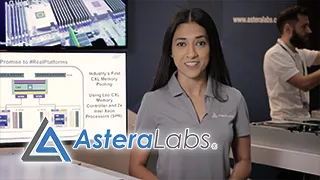
Astera Labs Leo CXL Memory Platform — Product Launch
Read Full Transcript of This Video
Transcript: Astera Labs Leo CXL Memory Platform — Product Launch
**Aanchal Sharma, Senior Director of Project Management, Astera Labs:** Hi everyone. Thank you for joining us. Today is a really exciting day for Astera Labs and the whole cloud computing industry.
I'm thrilled to share with you that we are now sampling our first product in the line of CXL memory connectivity platforms: Leo.
I am Aanchal Sharma, product manager at Astera Labs, and together with Avinash Sharma, Senior Director of Field Applications Engineering, will walk you through the industry's first purpose-built CXL platform for extending and pooling memory in the cloud to support complex data-centric workloads such as AI and machine learning.
But first, let us look at the industry trends and the memory bottlenecks that Leo's addressing.
The services and applications that you and I use on a daily basis have triggered an exponential growth in cloud computing and memory demand.
To address this challenge, processor vendors are packing more cores in their CPUs and GPUs. However, due to actual physical constraints, the amount of memory available per core is still declining at an alarming pace.
Additionally, since memory is tied to an individual host, the inability to share or pool memory resources between CPUs and GPUs in a heterogeneous environment is leading to under utilization of memory and an overall increase in total cost of ownership. Introducing Astera Lab's Leo CXL memory connectivity platform, the industry's leading purpose-built SOCs and turnkey solutions that support both memory expansion and memory pooling to solve these bottlenecks and capacity constraints.
LEO supports industry leading CXL 2.0 specification to increase memory bandwidth by up to 89.6 gigabytes per second and increase capacity by up to two terabytes of dram.
LEO is also the industry's first low-latency CXL memory pooling SOC to allow multiple processors or accelerators to pool and share memory, enabling efficient utilization of centralized memory resources at scale while improving the overall system performance.
Industry Leading cloud service providers and data center operators prefer LEO for the following reasons:
First, Leo is purpose built for cloud scale deployment targeting workloads such as AI and machine learning.
Second, it offers server-grade customizable RAAs, end-to-end security and software APIs to integrate with fleet management services.
Third, it features a flexible and scalable memory interface with a low-latency data path.
And finally, LEO is designed and tested to seamlessly interoperate with all major CPUs, GPUs, and memory vendors making it easy to manage, debug, and deploy at scale.
With that, let's watch Leo in action.
**Avinash Sharma, Senior Director of Field Applications Engineering:** Thank you Aanchal, and hello everyone. While there's a lot of traction about the CXL technology in the data center industry, we are here to demonstrate it first.
The LEO system validation board comes in a PCI Express by 16 chem form factor, has a deba connector to access the fleet management features, and is popular with four DDFI rdimms.
In this demo, we are showcasing the LEO system validation board with the next generation CPUs operating at PCX Express GenFi speeds supporting CXL to demonstrate memory expansion.
As you can see here, there are two Leo SVBs in a system. One of them is in a by 16 mode fully enumerated at PCI Express Gen 5 speeds in L0 state attached to the CPU in socket 0, whereas the second Leo SVB is in a x8 mode fully enumerated at PCI express Gen 5 speeds in L0 state attached to the CPU in socket 1. LSPCI shows that both LEO devices are in CXL mode with .io and .man modes for all lanes.
When we run Numa Control, we see that total of 256 gigabyte of DDr5 memory across both LEO devices successfully detected using CXL. We are also running industry standard stress app workload on the system to stress LEO devices and it passes successfully.
**Aanchal Sharma, Senior Director of Project Management, Astera Labs:** Thank you Avi. Now that we have successfully demonstrated Leo, let's take a look at the product variance that Astera Labs is now sampling.
LEO E-Series CXL Smart Memory controllers with support for memory expansion.
LEO P-Series CXL Smart Memory controllers with support for memory pooling, sharing, and expansion. Astera Labs is also announcing the Aurora A-sseries CXL Smart Memory Solutions in an add-in card form factor for customers looking for quick plug and play solutions with faster time to market.
In conclusion, whether you're looking to solve memory bandwidth and capacity bottlenecks, or looking to reduce your overall TCO, Astera Labs' class-defining Leo CXL memory connectivity platforms and other purpose built solutions have you covered.
Visit asteralabs.com to learn more.
About This Video
Astera Labs launched Leo, the industry's first purpose-built CXL (Compute Express Link) memory connectivity platform for cloud-scale AI and machine learning workloads. The problem Leo solves: as processors pack more cores into CPUs and GPUs, available memory per core is declining — and because memory is tied to individual hosts, it can't be shared or pooled across CPUs and GPUs in a heterogeneous environment. Leo supports CXL 2.0 for up to 89.6 GB/s bandwidth and 2TB of DRAM capacity, and is the first low-latency CXL memory pooling SOC to let multiple processors share memory at scale. The launch video includes a live demo of memory expansion on next-generation Intel CPUs, plus an introduction to the Leo E Series (memory expansion), Leo P Series (memory pooling, sharing, and expansion), and Aurora AC Series (plug-and-play add-in card form factor). For <span class="strong">product demo video production</span> in the semiconductor and data center space, technical accuracy and live demonstration credibility matter more than polish. Showing a real system running real workloads — and having it pass — is the proof the audience needs.
How do you produce a product launch video for a semiconductor or data center product?
Lead with the problem the product solves, then demonstrate the solution in a live system. The audience for a semiconductor product launch is technical — engineers, architects, and product managers who will evaluate the claims against what they know about the problem. A video that describes the problem accurately (memory per core declining as processors scale, memory tied to individual hosts) and then shows a working solution on real hardware is more credible than one that leads with marketing language. The live demo is the proof.
What should a CXL or memory connectivity product demo video include?
A clear explanation of the problem, a specific statement of how the product addresses it, and a live demonstration that's verifiable on screen. For Leo, that means showing the system configuration, running lspci to confirm the device is detected, running numactl to show memory pooling between two CPUs, and running stressapp to verify the system passes under load. Each step should be labeled and narrated so the viewer can follow what's happening and why it matters.
How do you structure a technical product launch video for a B2B semiconductor audience?
Industry context → product introduction → technical specifications → live demo → product variants and availability. That structure mirrors how a technical buyer evaluates a new product: they want to understand the market problem first, then see what the product claims, then verify those claims in a working system. The final section — product variants and how to learn more — converts interest into action. Skip any of these steps and the video either confuses the audience or fails to convert.
How long should a semiconductor or data center product launch video be?
Eight to twelve minutes for a full launch webinar format that includes context, product intro, live demo, and Q&A. Five to seven minutes for a focused product video without the webinar framing. The technical audience for a CXL product launch is willing to watch a longer video if every minute adds something new — another specification, another system configuration, another demo. Cut aggressively if a section repeats something already shown. The demo sections in particular should be tight.