Product Demo Video Production
Omron OL-450S — Real-World Application at Omron's Pleasanton Facility
Read Full Transcript of This Video
Transcript: Omron OL-450S — Real-World Application at Omron's Pleasanton Facility
In the past-paced world of manufacturing, every second counts. In efficiencies and bottlenecks can bring operations to a grinding halt, leading to delays, or even complete pauses. The key challenge, to optimize material flow and boost productivity.
Omron robotics and safety technologies, based in Pleasant and California, encountered these challenges in their production process. Their facility is designed for high mix, low volume manufacturing, with production lines, servicing robots and assembling of a variety of products, including various robots, safety laser scanners, safety light curtains, and more.
Each with unique requirements and complexities.
**Omron Representative:** Our team in Pleasant and Manufacturers a wide variety of products and manually transport them throughout the facility. Being a robotics company, we wanted to find an automation solution that could be highly adaptable and help relieve our team from mundane or competitive tasks.
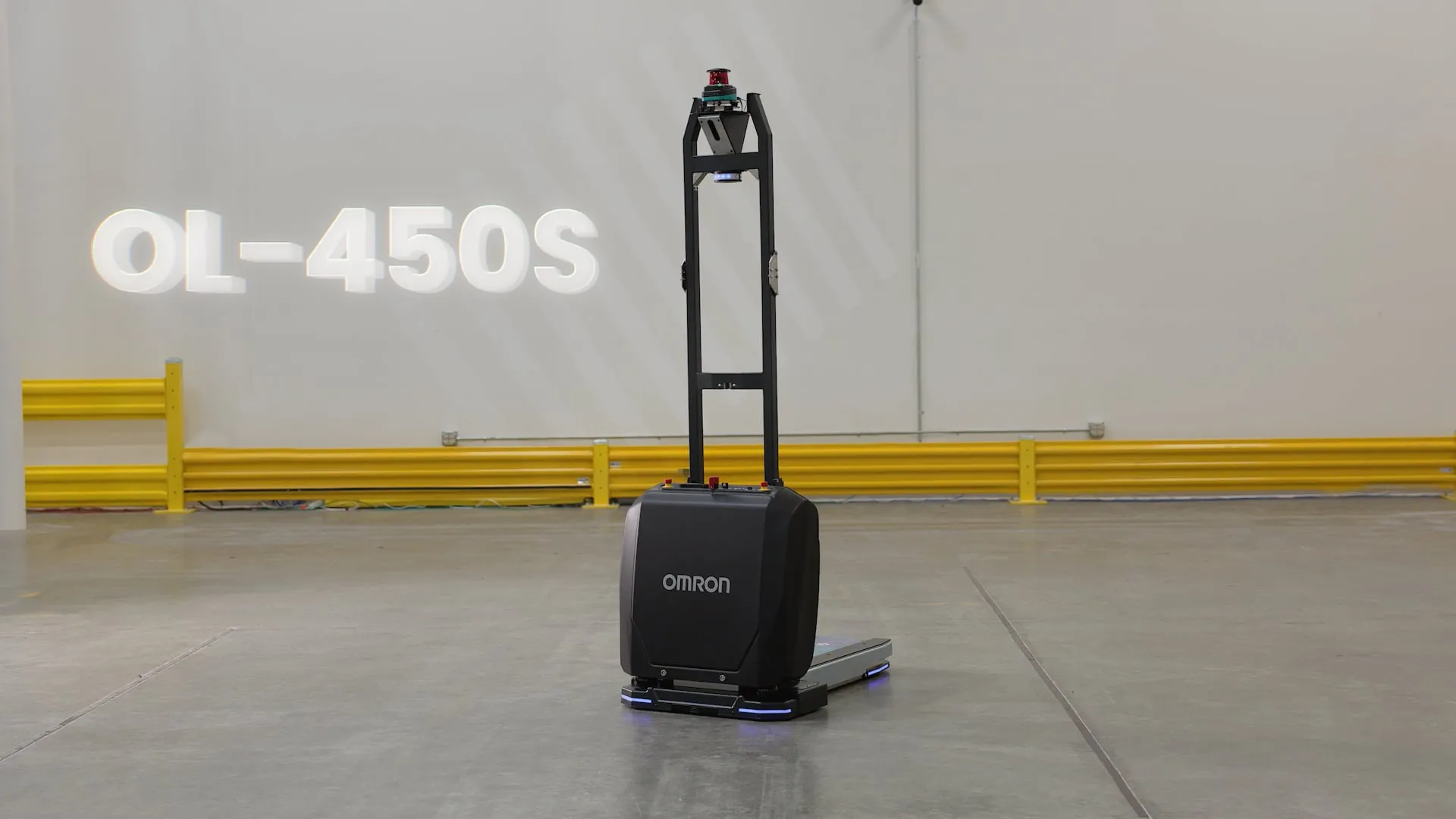
Enter the OL450S, an autonomous mobile robot designed to transform such environments. Equipped with advanced technology, like lidar sensors and omnidirectional drive capabilities, the OL-450S is more than just a machine - it's a solution.
Omron robotics and safety technologies chose the OL-450S because it met several critical needs that were essential for their dynamic and demanding environment. The first of these requirements: flexible operations.
The OL450S is driven by Omron's intuitive, Flowcore software, empowering operators to effort lessly manage job assignments, orchestrate traffic flow, optimize charging schedules, and implement updates with ease.
As production lines evolve, Omron's technology effortlessly adapts to changing needs. Whether the you need more of the same robot type, or a mixed fleet, Omron's platform and comprehensive AMR offering empowers you to scale and optimize your operations seamlessly.
**Speaker:** The ease of use and flexibility were key factors in choosing Omron's for this project. Our production flow required different robots to work together and adapt to changing needs. No two days are the same, and the demands and their robots are always evolving.
Additionally, the OL-450S comes standard with wireless charging, enabling flexible deployment, simplified management, and uninterrupted workflow.
The second requirement: safety. Safety is always a top priority. For improved localization and obstacle avoidance, the OL-450S features 360 degree lidar coverage with sensors at two levels, the base and the top of the two meter mast.
The 360 degree sensor suite scans the local area to ensure safe passage and detect potential obstacles.
**Speaker:** Safety was a nannegosible for us. The OL450S advanced lidar sensors and safety features gave us the confidence that our team and equipment would be protected at all times.
Third, advanced navigational capabilities. The OL-450S is an omnidirectional robot, capable of forward, reverse, and lateral movement. This is crucial for navigating close to walls, or in narrow aisles where rotation isn't possible.
**Speaker:** Our production flow required navigating narrow aisles alongside multiple robot types. OL-450's lateral movement capability enabled us to accomplish tasks without modifying the facility layout.
And lastly: load handling capabilities. One of the standout features of the OL450S is its exceptional lifting capabilities.
This autonomous mobile robot is designed to handle payloads up to 450 kilograms, and a wide variety of load carriers, making it incredibly versatile for different types of material handling tasks.
This is particularly beneficial in dynamic environments where the types of materials being transported can vary significantly. Whether you're dealing with kitting racks, trolleys, carts, or other types of carriers, the OL-450S can seamlessly integrate into your existing workflow.
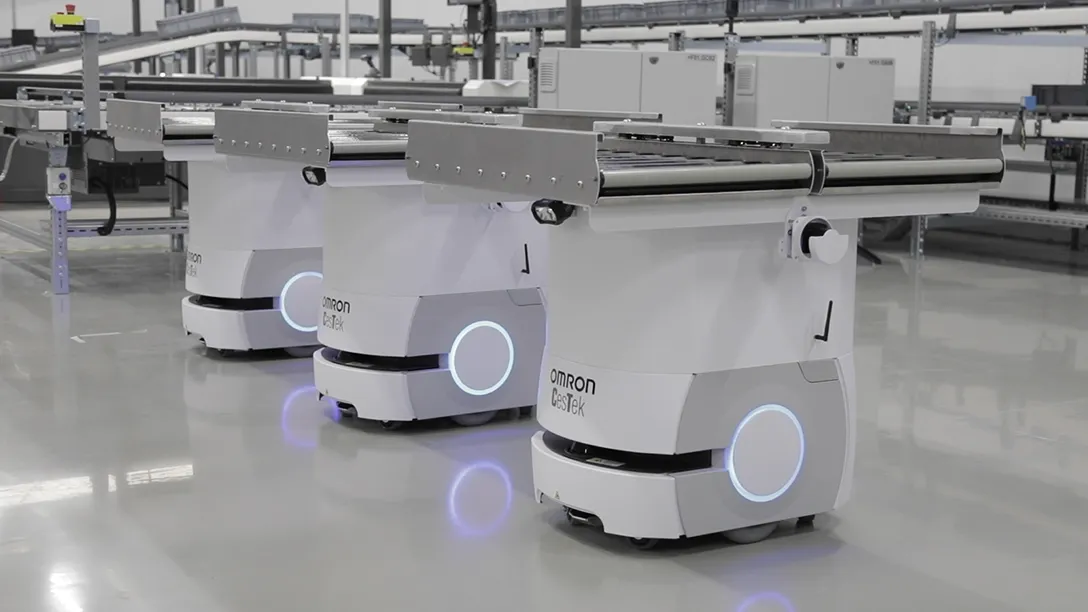
Since load carriers aren't attached to the robot, it offers superior flexibility and adaptability. This independence allows the OL-450S to effectively manage multiple assembly lines, swiftly perform pickups and drop-offs, and boost operational efficiency.
Beyond streamlining operations, the advanced automation of the OL-450S enhances reliability and traceability. With precise tracking of part movements, the robot ensures that components reach their intended destinations, maintaining accurate and efficient production processes.
**Speaker:** One of the biggest challenges we face was handling different types of load carrier sufficient. OL-450S' ability to manage various carriers seamlessly has been a significant advantage for us. It has allowed us to streamline our operations and reduce the time spent on manual adjustments.
The robot's robust lifting capabilities ensure that loads are securely transported from one location to another, minimizing the risk of damage or mishandling. Whether you're dealing with lightweight components or heavier materials, the OL-450S can handle at all, with precision and reliability.
The OL-450S is a versatile and adaptable AMR solution that can revolutionize your production and material handling operations. It can handle different types of load carriers, navigate difficult environments, and work well with existing systems. This makes it a useful tool for businesses of all sizes.
Since implementing the OL-450S, Omron has seen over a 30% increase in productivity and efficiency throughout the facility. The robots have seamlessly integrated into their operations, providing a reliable and efficient solution.
**Speaker:** The OL450S has been a game changer for us. It has not only improved our workflow, but also allowed our team to focus on more strategic tasks. We couldn't be happier with the results.
By incorporating the OL-450S into your operations, you can automate repetitive tasks and improve workflow for increased efficiency, improve safety, and reduce the risk of accidents and injuries, and adapt to changing business needs and market demands, ensuring flexibility.
Ready to take your operations to the next level? Contact us today to learn more about the OL-450S and how it can benefit your business.
About This Video
Omron Robotics & Safety Technologies deploys their own OL-450S autonomous mobile robots at their Pleasanton, California manufacturing facility. This video documents that deployment — making it a case study where the manufacturer is also the customer. The context is high-mix, low-volume production: a facility building a wide variety of products, including robots themselves, where no two days have exactly the same demand. "Our team manually transports products throughout the facility," the video opens. "As a robotics company, we wanted to find an automation solution that was highly adaptable." The video works through four requirements that drove the selection — flexible operations, safety, navigation, and load handling — and closes with the result: more than 30 percent increase in productivity and efficiency. The "flexible operations" section covers Flow Core software and wireless charging. Safety addresses the 360-degree lidar at two levels. Navigation focuses on omnidirectional movement through narrow aisles without facility modifications. Load handling explains how unattached carriers let a single robot serve multiple assembly lines. The <span class="strong">product demo video</span> format used here — real facility, real problem, structured requirements, quantified outcome — is the version of a product video that actually helps a procurement team justify a purchase decision.
What should a product application case study video include?
A real problem, a structured selection process, and a measurable outcome. Omron's OL-450S application video works because it's structured the way a procurement decision is made: four requirements (flexible operations, safety, navigation, load handling), each addressed with evidence. The payoff is specific: over 30% increase in productivity and efficiency. That number is the difference between a product video that informs and one that justifies a budget request.
Why is self-deployment an effective case study strategy for a product company?
Because it removes the most common objection: 'the only case studies they have are paid testimonials.' When Omron uses their own OL-450S in their own Pleasanton factory, they're making the argument that they trust the product enough to bet their own production on it. 'As a robotics company, we wanted to find an automation solution that was highly adaptable' — that line does more for credibility than any third-party quote could.
How do you demonstrate ROI in an industrial product video?
With a specific number and the context that makes it believable. A 30% productivity increase is a strong claim. It lands because the video earns it: first describing the problem (bottlenecks in high-mix manufacturing), then the solution (four-requirement OL-450S deployment), then the result. If the 30% number appeared without that setup, it would feel like marketing. With it, it's evidence.
How do you film a case study video for a robot deployment in a manufacturing facility?
Ground it in the customer's specific environment, then structure it around their decision criteria. Omron's video is specific about the facility: high-mix, low-volume production, narrow aisles, multiple assembly lines, changing daily demands. 'No two days are the same.' That specificity makes the case study feel real. Then the four requirements give the video structure — each section addresses one aspect of the buying decision, in order of priority. The result is a case study that serves both as a product video and a buyer's guide.