Product Demo Video Production
Omron OL-450S Autonomous Mobile Robot — Product Launch Video
Read Full Transcript of This Video
Transcript: Omron OL-450S Autonomous Mobile Robot — Product Launch Video
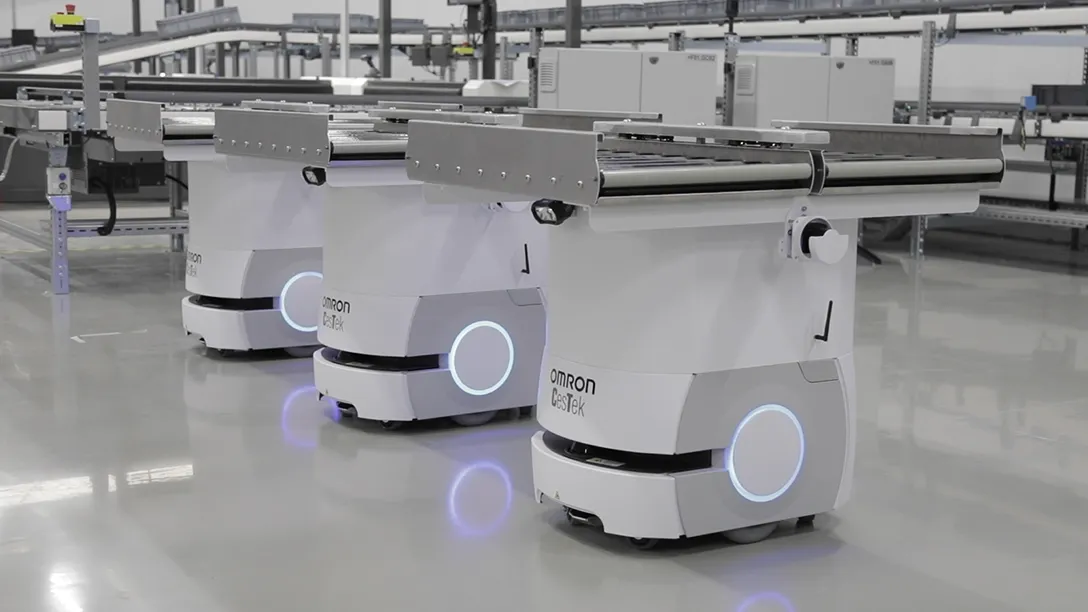
Welcome to the Omron OL-450S. Omron's low profile autonomous mobile robot.
With a payload capacity of 450 kilograms, and a deck height of only 108 millimeters, the OL-450S is the ideal solution for rack and cart transport needs.
With decades of experience developing mobile robots and fleet management software, Omron has developed a lineup of mobile robots with payload capacities ranging from 60 kilograms up to 1500 kilograms.
The OL-450S is the first low-profile robot in Omeron's product line, as well as the first omni-directional robot. This allows for forward and reverse navigation, as well as lateral movement, allowing the robot to find the most efficient path from point A to point B.
Improving efficiency even more is the OL-450S top speed of 1.2 meters per second, just over 2.5 miles per hour.
The lifting platform has a height of 108 millimeters, and a width of 446 millimeters, so it can easily handle most industrial racks and carts.
The platform extends up to 308 millimeters, the highest in the industry, so it can lift carts with a high touch point.
As with all Omron AMRs, the OL-450S is compatible with existing Omron mobile robot infrastructure, and can be quickly and easily added to an existing Omron fleet.
No tracks, tapes, or markers are required, so changes can be made to the manufacturing flow with no disruption or facility changes.
All of the features and capabilities of the OL-450S can be managed using Omron's powerful Flow Core software. So all assignments, traffic control, charging schedules, and updates can be handled by a single platform.
With its advanced 360-degree lidar systems, the OL-450S can adjust its safety zone and speed to safely maneuver through predefined areas that would be hazardous to pass through at full speed.
Additional floor sensors located at the base of the robot, and the raised 360-degree lidar can identify and detect objects or obstacles in its path.
A rear-facing lidar sensor enables the OL-450S to accurately identify and align with loads, reducing cycle times, and maximizing productivity.
The OL 450S is the first Omron AMR that comes standard with wireless charging. This high-speed frictionless charging system can deliver seven hours of operation on a 40-minute charge.
Charging schedules can be handled through Omron's Fleet Manager, with jobs and tasks assigned to the robot with enough power to complete the job, while others charge as needed.
Omron has been leading the way in mobile robotics for decades, and we continue to bring new products to market to increase production and efficiency.
Talk to your Omeron representative to learn more about Omron's full suite of robotics and automation products.
About This Video
The OL-450S is Omron's first low-profile autonomous mobile robot and its first omnidirectional AMR. Those two "firsts" do most of the work in the launch video — they mark the product as a genuine addition to the lineup, not a refresh. The deck height is 108 millimeters. Payload capacity is 450 kilograms. Top speed is 1.2 meters per second, just over 2.5 miles per hour. The lift platform extends to 308 millimeters — highest in the industry, the video notes — which means it can engage carts with a high touch point that other low-profile robots can't reach. What makes the video worth watching for a B2B buyer is the specificity. The omnidirectional drive means forward, reverse, and lateral movement — so the robot finds the most efficient path rather than just going straight. No tracks, tapes, or markers means no facility modifications when the manufacturing flow changes. Flow Core software handles assignments, traffic control, charging schedules, and updates on a single platform. The wireless charging system runs seven hours off a forty-minute charge — the first Omron AMR to come standard with it. Those are the details that turn a <span class="strong">product demo video</span> into a sales tool.
What should a product launch video for an industrial robot include?
Lead with the differentiators, then support with specs. Omron's OL-450S launch video works because it opens with two 'firsts' — first low-profile AMR in Omron's lineup, first omnidirectional AMR — before diving into numbers. That framing tells a procurement audience why this product matters before asking them to evaluate it. The specs (450 kg payload, 108 mm deck height, 308 mm lift extension, 1.2 m/s speed) support the argument; they don't make it.
How do you structure a technical product video for B2B manufacturing buyers?
Organize it the way a sales conversation would go: differentiators first, key specs next, software and integration details for the operations team, safety for the compliance team, and a clear CTA. The OL-450S launch video follows that order exactly. Buyers don't need every specification — they need to know what makes this robot different from the ones they've already looked at. Everything else is secondary to answering that question.
What makes an omnidirectional AMR different from a standard robot, and how should that be communicated on video?
Omnidirectional movement means the robot can move forward, reverse, and laterally — which matters in environments where rotating isn't possible, like narrow aisles. The OL-450S video makes this point quickly and precisely: 'allowing the robot to find the most efficient path from point A to point B.' That sentence is the right level of detail for a launch video — clear enough to be meaningful to an operations buyer, brief enough not to lose anyone.
Why does wireless charging matter for autonomous mobile robot deployments?
Because it removes the need for a dedicated docking station, simplifies deployment, and allows flexible fleet management. The OL-450S is Omron's first AMR to come standard with wireless charging, delivering seven hours of operation from a forty-minute charge. Fleet managers can schedule charging through Omron's Flow Core platform, so robots charge between assignments rather than going offline for extended periods. That kind of operational detail is what manufacturing buyers need to evaluate whether the product fits their workflow.